June 27, 2026
The Dealership Was Built for a Buyer Who No Longer Exists
Why the traditional dealership model no longer fits the way modern customers research, decide, and buy.
Your customer did not start buying the car when they walked into your showroom.
They started long before that.
They searched online. Compared models. Watched reviews. Checked inventory. Looked at prices. Calculated payments. Read customer comments. Asked friends. Maybe even explored financing before speaking to anyone at the dealership.
By the time many customers arrive, they are no longer at the beginning of the journey.
They are much closer to a decision than dealerships sometimes assume.
I see this in the dealership every day. Customers do not arrive uninformed anymore. They arrive with screenshots, comparisons, payment expectations, and a clear sense of what “professional” should feel like.
I also see it in myself as a customer. Before I buy almost anything today, I watch real-use reviews, compare ownership experiences, and look for real cases from people who have already used the product. So why would we expect automotive customers to behave differently?
And that changes everything.
For decades, the dealership was the center of the car-buying process. Customers came to the showroom to see what was available, understand the differences between models, compare prices, discuss trade-in value, explore finance options, and make a decision.
The showroom was not only where the deal closed.
It was where the customer learned.
That world has not disappeared completely, but it has changed dramatically. Today’s buyer arrives with more information, higher expectations, and less patience for friction. They may not know every detail, but they know enough to sense when something feels slow, vague, inconsistent, or disconnected from what they already found online.
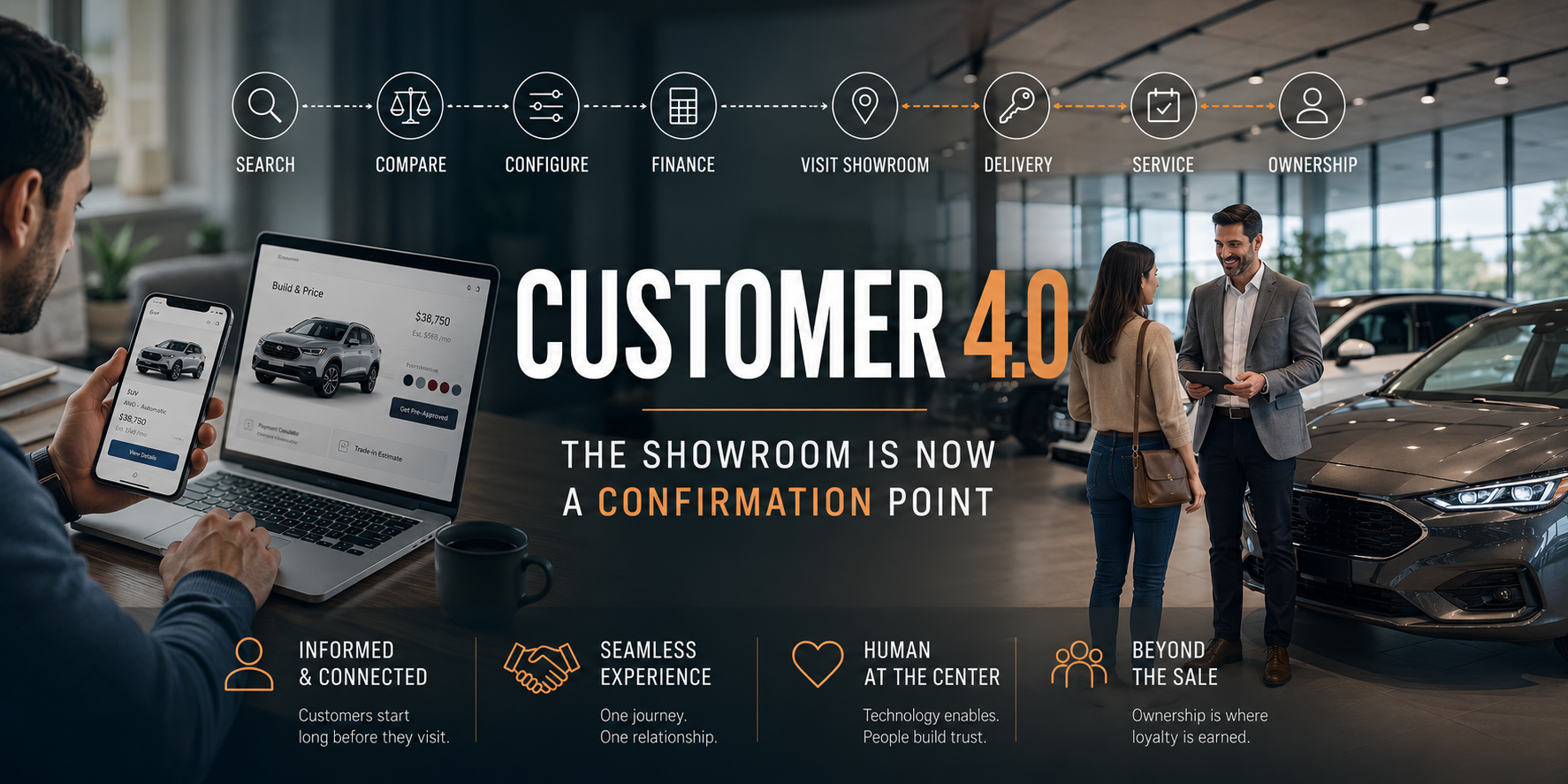
This is the arrival of Customer 4.0.
Customer 4.0 is not simply a “digital customer.” That definition is too narrow.
Customer 4.0 is informed, connected, impatient, skeptical, and still very human. They move between online and offline channels without thinking about them as separate worlds. They expect the website, salesperson, finance office, service department, CRM, OEM platform, and delivery process to feel like one connected experience.
Internally, we may see different departments.
The customer sees one brand.
And when that experience feels fragmented, they do not blame the software, the system, or the process.
They blame the dealership.
The dealership was built around information control
The traditional dealership model was built around a simple assumption: the customer needed the dealer to access information.
If the buyer wanted to know what was available, they came to the store.
If they wanted to understand pricing, they spoke to a salesperson.
If they wanted to compare models, they walked the lot.
If they wanted to evaluate finance options, they sat with the dealership team.
If they wanted to know what their trade was worth, they waited for the manager’s number.
This gave the dealership enormous influence over the customer journey. The dealer controlled much of the information, the pace, and the sequence of the sale.
That model made sense for its time.
But Customer 4.0 does not enter the showroom empty-handed.
They arrive with screenshots, saved configurations, payment estimates, competitor comparisons, online reviews, YouTube opinions, trade-in expectations, and a strong impression of your reputation before your team says hello.
The old advantage was access to information.
The new advantage is the ability to create confidence.
That is a very different business.
Much of the decision now happens before the visit
One of the most important shifts in automotive retail is that customers often make much of the decision before contacting the dealership.
They may already know the model.
They may already know the trim.
They may already know the color, engine, range, payload, monthly payment target, and competing alternatives.
They may already have decided whether your dealership feels trustworthy based on your digital presence.
This means the showroom visit is no longer only about discovery.
It is increasingly about confirmation.
The customer is asking, consciously or subconsciously:
Is this the vehicle I researched?
Is this the payment I expected?
Is this trade-in explanation fair?
Is this dealership as professional in person as it looked online?
Can I trust these people after the sale?
Will service be as strong as sales?
Every interaction either confirms the decision or reopens doubt.
A slow response can create doubt.
A different price can create doubt.
A salesperson who has no idea what the customer submitted online can create doubt.
A finance process that feels disconnected from the earlier conversation can create doubt.
A delivery experience that feels rushed can create doubt.
And once doubt enters the process, Customer 4.0 has options.
They can compare again. Search again. Message another dealer. Read another review. Walk away quietly.
The customer does not need to argue anymore.
They can simply leave.
The showroom has become a confirmation point
This does not mean the physical dealership no longer matters.
Actually, it may matter more than ever.
But its role has changed.
The showroom is no longer the place where the dealership controls the customer’s access to information. It is the place where the dealership proves whether it can be trusted.
That is a powerful shift.
A customer who has spent hours researching online does not want to restart the process from zero. They do not want to explain the same information to three different people. They do not want to hear that the vehicle they configured online is not actually available. They do not want to feel that the online experience and the in-store experience belong to two different companies.
Inside the dealership, those gaps may feel operational.
To the customer, they feel personal.
They create the impression that the dealership does not listen, does not remember, or does not respect the customer’s time.
Most of the time, the issue is not bad intention.
It is fragmentation.
Marketing creates the lead.
The BDC follows up.
The salesperson receives partial notes.
The manager controls the deal structure.
Finance starts a new conversation.
Service may not become part of the relationship until months later.
Internally, each step may seem normal.
Externally, it can feel like the dealership has amnesia.
In simple terms, the customer expects us to remember what they already told us.
If they configured a vehicle online, the salesperson should know.
If they submitted a trade-in form, the dealership should be ready to discuss it.
If they asked a question through chat, they should not have to repeat it in the showroom.
If they bought from you, service should treat them like a known customer, not a new file.
This is no longer a luxury.
It is the baseline expectation.
The customer compares your dealership to every digital experience they know
Dealers often think their competition is the dealer across town.
That is only partly true.
Customer 4.0 compares your experience with the best digital experiences in their life: banking, travel, delivery, e-commerce, insurance, and service scheduling.
So when buying or servicing a vehicle feels confusing, slow, or opaque, the customer does not think, “This is just how dealerships work.”
They think, “Why is this still this difficult?”
That question is dangerous because it changes the emotional frame.
The customer may still need the dealership.
But they no longer automatically accept dealership friction as normal.
This is especially important in service and aftersales. A customer may tolerate some complexity during a major purchase, but repeated friction during ownership damages loyalty quickly.
If scheduling is hard, communication is unclear, updates are late, or the customer has to chase the advisor for information, the relationship weakens.
Customer 4.0 does not judge the dealership only at the moment of sale.
They keep judging during ownership.
That means every service visit, follow-up call, WhatsApp message, email, delivery handover, and problem resolution becomes part of the brand experience.
The salesperson’s role is changing
This shift does not make salespeople less important.
It makes the right kind of salesperson more important.
The old salesperson succeeded by presenting information the customer did not have.
The new salesperson succeeds by helping the customer make sense of the information they already have.
That requires a different skill set.
Less script.
More judgment.
Less pressure.
More guidance.
Less “let me show you everything.”
More “let’s understand what matters to you.”
Customer 4.0 does not need a gatekeeper.
They need a guide.
A good salesperson today should be able to say:
“I see you were looking at this model online. Let’s pick up from there.”
That sentence alone changes the tone of the relationship.
It tells the customer: we listened, we remember, and we respect your time.
This is where human interaction still wins. Digital tools can provide information, but they cannot fully replace reassurance, empathy, judgment, and trust in a high-value decision.
A vehicle purchase is still emotional. It is expensive. It affects family, business, safety, status, mobility, and daily life.
The customer may want digital convenience.
But when the stakes are high, they still want a competent human being.
They just do not want that human being to slow everything down.
The real issue is not digital tools. It is operational readiness.
Many dealerships have already invested in digital tools.
Websites. CRMs. Lead forms. Chat tools. Online finance applications. Digital retailing platforms. Service schedulers. Review systems. Customer databases.
But technology alone does not create transformation.
A dealership can have all the tools and still deliver a fragmented experience.
The real question is not, “Do we have digital tools?”
The real question is:
Can the customer move from online to in-store without losing progress?
Can our team see the customer’s previous activity?
Can sales, finance, delivery, and service operate from the same understanding of the relationship?
Do our online promises match the showroom reality?
Can we personalize communication without making it feel robotic?
Can we follow up after delivery in a way that creates loyalty instead of noise?
Can we make the customer feel known?
That is the difference between digital adoption and digital readiness.
Customer 4.0 does not care how many systems the dealership uses.
They care whether the experience works.
The dealership is not dead. The old dealership logic is.
There is a common mistake in conversations about the future of automotive retail.
Some people assume that because customers are more digital, the dealership becomes less relevant.
I do not believe that.
The dealership still matters.
Local trust matters.
Physical service capacity matters.
Trade-in expertise matters.
Delivery support matters.
Human judgment matters.
Problem-solving matters.
Community presence matters.
But the logic of the dealership must change.
The dealership can no longer depend on being the customer’s first source of information.
It must become the customer’s most trusted source of confidence.
That is a higher standard.
It means the dealership’s job is not only to sell the vehicle. It is to orchestrate the journey: online research, showroom experience, finance, delivery, service, ownership, renewal, and retention.
The strongest dealers of the future will not be the ones that fight Customer 4.0.
They will be the ones that design around them.
They will respect the customer’s research.
They will continue the journey instead of restarting it.
They will connect departments around the customer, not force the customer to navigate departments.
They will use technology to make human interaction better, not colder.
They will understand that the sale is not the end of the journey.
It is the beginning of the relationship.
The real question for dealers
Customer 4.0 has already walked into your showroom.
They are informed.
They are connected.
They are comparing.
They are skeptical.
They are impatient with friction.
But they are still willing to trust the right people.
That is the opportunity.
The question is not whether customers have changed.
They have.
The question is whether the dealership is still organized around a buyer who no longer exists.
Because the modern customer is not waiting for us to explain the old process.
They are waiting for us to build a better one.